


Leaders Share Wisdom and Support: Ruitai's Poverty Alleviation Sets Clear Direction
2026-01-21浏览量:0
In the process of targeted poverty alleviation, grassroots exploration requires guidance from the top. In November 2014, Liu Yongfu, Director of the State Council Leading Group Office of Poverty Alleviation and Development, and Zhao Yong, Deputy Secretary of the Hebei Provincial Party Committee, made a special trip to Chengde Ruitai's predecessor - Xinglong County Ruitai Fruit and Vegetable Farming Cooperative, to preside over an on-site meeting for targeted poverty alleviation. This research and guidance served both as a field inspection of the cooperative's previous poverty alleviation work and provided a practical pathway for the hawthorn industry to help in the fight against poverty.
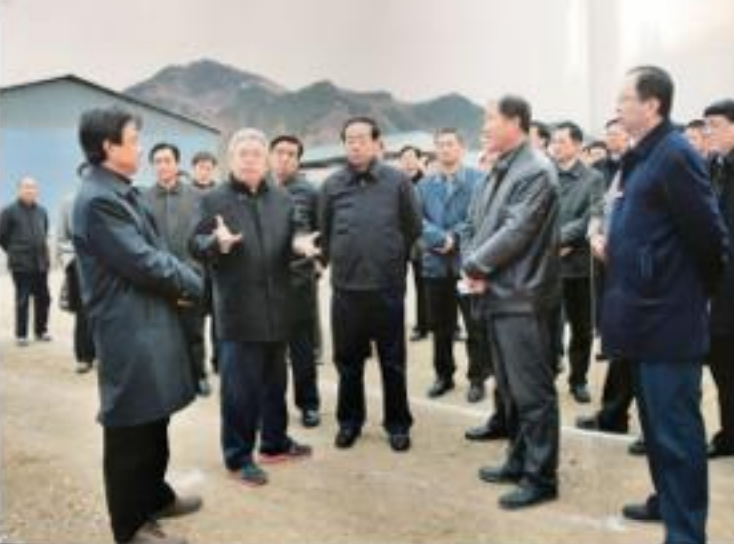
◄ Director Liu Yongfu of the State Council Poverty Alleviation Office and Deputy Provincial Party Secretary Zhao Yong holding an on-site targeted poverty alleviation meeting at our cooperative in November 2014
In the cooperative's core hawthorn plantation area, Director Liu and Deputy Secretary Zhao walked into the fields to carefully examine the hawthorn fruit conditions and engaged in face-to-face discussions with cooperative leaders and representative farmers. "How many impoverished households have joined the cooperative? How much more money can one acre of hawthorn earn compared to before?" "Is technical guidance sufficient? Are sales channels guaranteed?" The leaders raised these questions that concerned the farmers. Upon learning that the cooperative had already attracted over a hundred farming households but some impoverished households still had reservations due to lack of planting experience and insufficient investment capacity, Director Liu emphasized, "The key to industrial poverty alleviation is connecting 'small farmers' to the 'big market,' and cooperatives must effectively help farmers resolve their concerns about technology and sales channels." Deputy Secretary Zhao added that they should leverage Xinglong's advantages as a hawthorn production base and implement poverty alleviation measures in specific planting and processing segments.
During the on-site meeting, the cooperative reported in detail on initial assistance measures such as "contract farming" and "unified purchasing." Director Liu approved the cooperative's commitment to a "minimum price guarantee for fruit purchase" while offering specific improvement suggestions: "You can explore a model of 'land shareholding + labour income,' allowing impoverished households to earn both rent and wages." Deputy Secretary Zhao instructed local relevant departments to provide necessary support for the cooperative's technical training and infrastructure construction. After the meeting, the cooperative quickly sorted through the leaders' suggestions and optimized their assistance plan: addressing the technical shortcomings of impoverished households by partnering with the county agricultural bureau to form basic technical service teams for regular rural training in pruning and fertilization; tackling investment difficulties by introducing flexible policies like "seedling credit + repayment after income" to lower participation barriers.
The leaders' on-site guidance made the cooperative's poverty alleviation approach clearer. With policy coordination and departmental support, the cooperative secured special poverty alleviation funds to upgrade irrigation facilities and build small sorting sheds, solving the problem of hawthorn spoilage after harvest. Old Li, a participating impoverished farmer, said: "Previously, when growing hawthorn independently, we couldn't get good prices and worried about sales; after joining the cooperative, we receive technical guidance and guaranteed purchase prices, which gives us peace of mind." This visible change is a vivid manifestation of the on-site meeting's results - the leaders' requirements transformed into specific measures benefiting every participating impoverished household.
This on-site meeting became a crucial turning point in the cooperative's development. Following the leaders' guidance to "build a solid industrial foundation," the cooperative gradually expanded its reach from the initial hundred-plus households to eventually include over 1,400 impoverished households, accumulating over 5 million yuan in increased income for farmers through share returns and dividends. The cooperation evolved from simple cultivation to include processing operations, transforming hawthorn from "fresh fruit" to "products," further enhancing the industry's added value.
Today, Chengde Ruitai, which has grown into a provincial-level poverty alleviation leading enterprise, continues to uphold the "practical poverty alleviation" concept advocated at the on-site meeting. The leaders' instructions in the hawthorn garden that day have been transformed into the company's operational principle of "developing together with farmers," making Xinglong hawthorn truly become a "prosperity fruit" that helps drive stable income increases for the masses.
Some content is reposted from the internet. Copyright belongs to the original authors. If infringement occurs, please contact us for removal. Content involving franchising or investment carries risks - exercise caution when making decisions.
